Scaling Wi-Fi with EVPN
Large campus networks are facing challenges supporting massive Layer 2 domains while ensuring seamless client mobility across campuses. It comes with significant hurdles. For years, IT teams have struggled with issues like ARP flooding, excessive hardware costs, and outdated proprietary solutions.
But do we still have to live through "the broadcast storms of the 1980s," as Ken Duda of Arista Networks aptly puts it?
Arista Networks believes there’s a better way forward. With their VESPA (Virtual ES with Path Aliasing) and MAC Rewrite Offload (MRO) solution, they’ve reimagined how large networks can address scalability, mobility, and roaming challenges. Let's explore how these technologies work, the problems they solve, and why they might be the go-to solution for scaling Wi-Fi in large environments.
Overcoming Layer 2 Mobility Challenges in Campus Networks
Maintaining seamless mobility across campus networks while addressing Layer 2 scalability issues has long been a challenge. Applications like SSH sessions or collaboration tools require IP addresses to remain consistent as clients roam, but scaling Layer 2 networks often leads to excessive broadcast traffic and inefficiency.
Traditionally, vendors have introduced their own proprietary hardware, such as wireless LAN controllers, to address these challenges. While these solutions are effective, they introduce added costs, complexity, and reliance on non-standardized protocols.
This is where Arista Networks’ VESPA and MRO technologies stand out. By leveraging industry-standard EVPN (Ethernet VPN), Arista removes the need for proprietary hardware and offers a scalable, efficient solution.
What Is VESPA?
VESPA (Virtual ES with Path Aliasing) leverages EVPN to address Layer 2 mobility challenges in a scalable manner. EVPN is a widely supported protocol that provides an overlay network, allowing organizations to create large Layer 2 domains while relying on a robust Layer 3 underlay for connectivity.
Here’s how VESPA works:
- Gateway Configuration on Existing Hardware: Instead of introducing new controllers or terminators, VESPA utilizes existing high-end routers on your network. These routers are configured with a virtual IP address for redundancy and high availability.
- AP Connectivity through VTEPs: Access points (APs) connect to the fabric via access switches, each assigned to a VTEP (Virtual Tunnel Endpoint). This enables seamless mobility without the need for proprietary protocols.
- Scalability: VESPA supports up to 300,000 clients and 30,000 access points, making it one of the most scalable solutions in the industry.
The Role of MAC Rewrite Offload (MRO)
While VESPA solves many Layer 2 scaling challenges, another critical issue lies in live client roaming across access points. Challenges like ARP flooding, MAC address table sizes, and low-latency roaming for applications like Wi-Fi calling often remain unresolved.
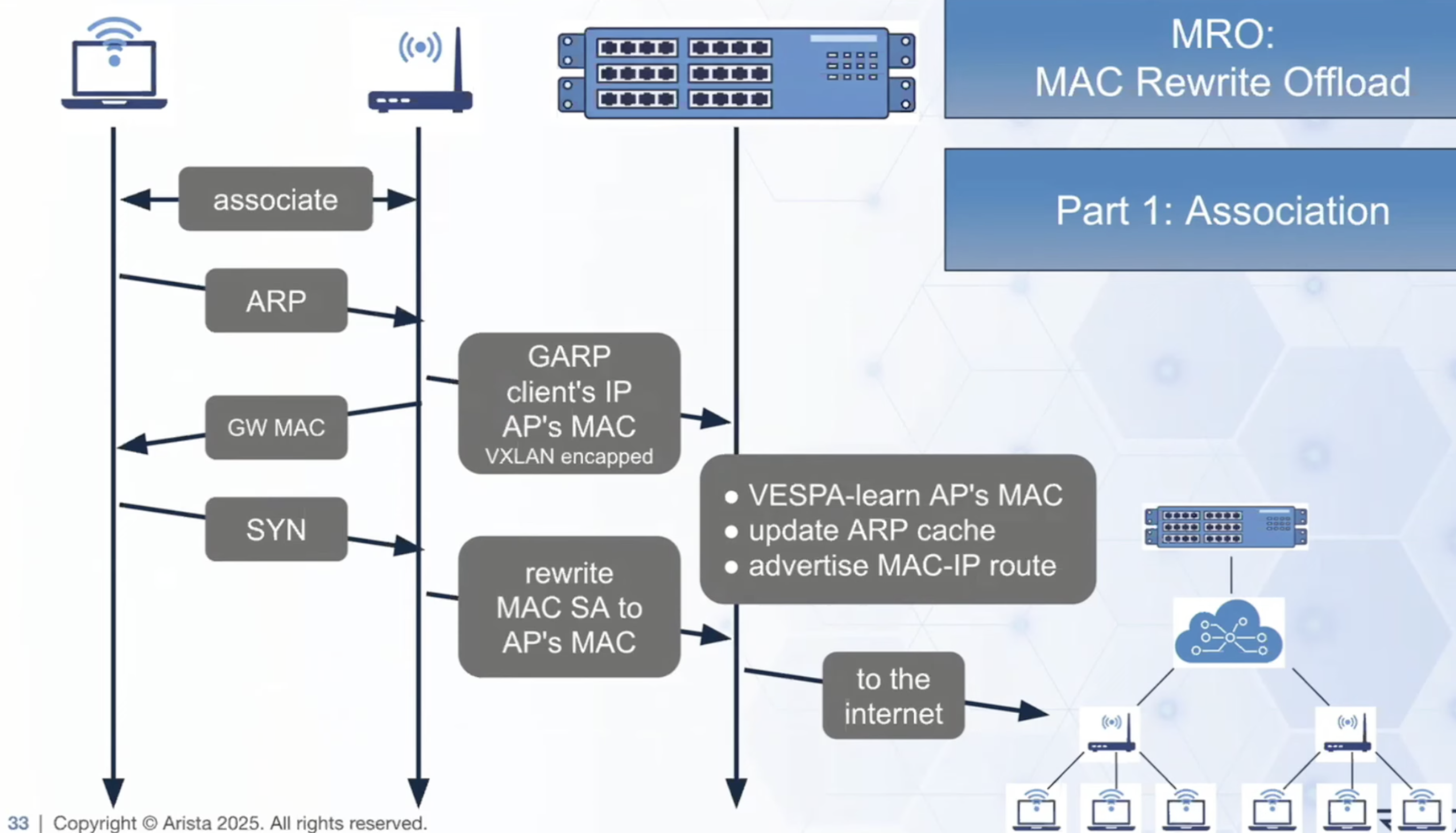
To bridge this gap, Arista Networks introduces MAC Rewrite Offload (MRO). Here’s how MRO enhances the Wi-Fi experience:
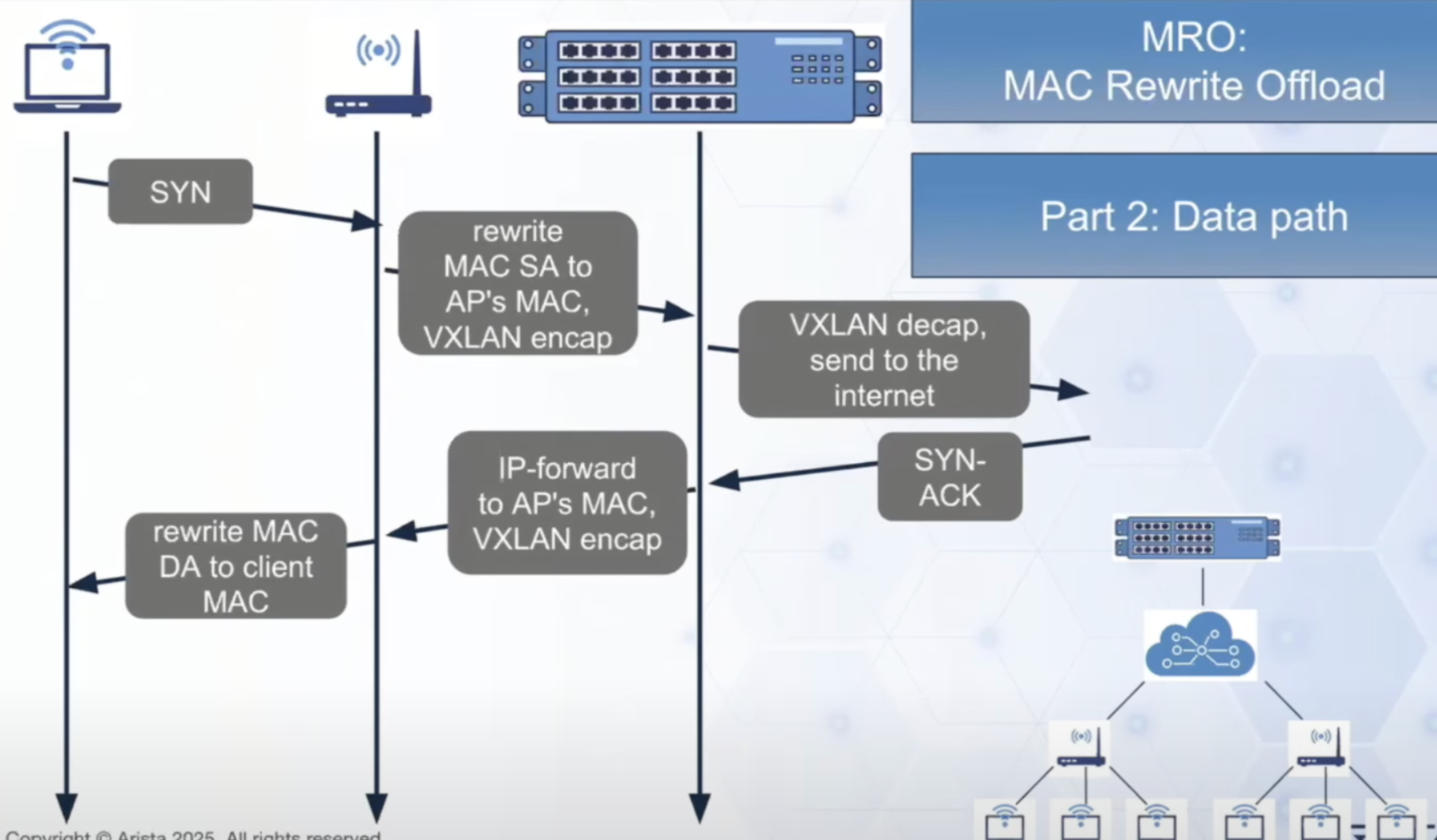
- Reducing Client Traffic: Instead of flooding the network with client updates during roaming, MRO enables the AP to handle these operations locally. The switches only process essential updates from the AP, not individual clients.
- Streamlining ARP Handling: Gratuitous ARPs are sent by the AP using its own MAC address on behalf of the client. This reduces unnecessary ARP traffic across the network, maintaining an efficient flow of data.
- Industry Standards: Both VESPA and MRO prioritize the use of open, widely supported standards like EVPN, ensuring compatibility and reducing vendor lock-in.
Why Choose Arista Networks?
Arista’s approach is built around leveraging what’s already in your network while eliminating the need for additional proprietary hardware. The benefits include:
- Cost Reduction: By using existing hardware and eliminating additional controllers, overall expenses are minimized.
- Standards-Based Protocols: EVPN ensures interoperability and future-proofing for network architectures.
- Simplified Operations: Unified management through Arista’s EOS (Extensible Operating System) provides consistent control across routers and switches.
- Impressive Scalability: Supporting 300k clients and 30k APs makes Arista one of the most scalable options for enterprise Wi-Fi.
Practical Considerations for Wi-Fi Engineers
While the benefits are clear, implementing a technology like VESPA/EVPN requires collaboration across multiple domains within IT. Wi-Fi engineers, Layer 3 network engineers, and systems architects must work together to design, configure, and test the solution. Some key considerations include:
- ARP Flooding Requirements: Understanding how gratuitous ARPs are handled and ensuring minimal network impact.
- Low Latency Roaming: Assessing performance for real-time applications like VoIP or Wi-Fi calling.
- MAC Address Table Scaling: Planning for the network's capacity to handle thousands of devices and APs.
Additionally, training and skill development for IT teams are essential. EVPN is a powerful yet complex protocol, requiring expertise in both Layer 2 and Layer 3 networking to deploy properly.
What Does the Future Hold for Wi-Fi Scalability?
Arista Networks’ focus on industry standards and scalable technology signals an exciting shift for large networks. The inclusion of EVPN in Wi-Fi configurations hints at broader adoption across vendors, pushing the industry toward more interoperable and efficient solutions.
That said, more real-world testing and case studies will provide valuable insights into how these technologies perform in large-scale deployments. Early adopters may face challenges, but the potential benefits far outweigh the initial hurdles.
Take the Next Step Toward Scaling Your Wi-Fi
Scaling Wi-Fi in large campus networks no longer requires clunky, proprietary solutions. With Arista Networks’ VESPA and MRO, you can achieve seamless mobility, reduced flooding, and unparalleled scalability without breaking the bank.
To learn more about how these innovations can transform your network, watch Arista’s presentation at Mobility Field Day 13 here. And for those just beginning to explore EVPN, start preparing your team for what’s ahead in networking.
Your network deserves to be efficient, scalable, and future-ready. Are you ready to make the switch?