The LCD Access Point: Wi-Fi Meets Digital Signage
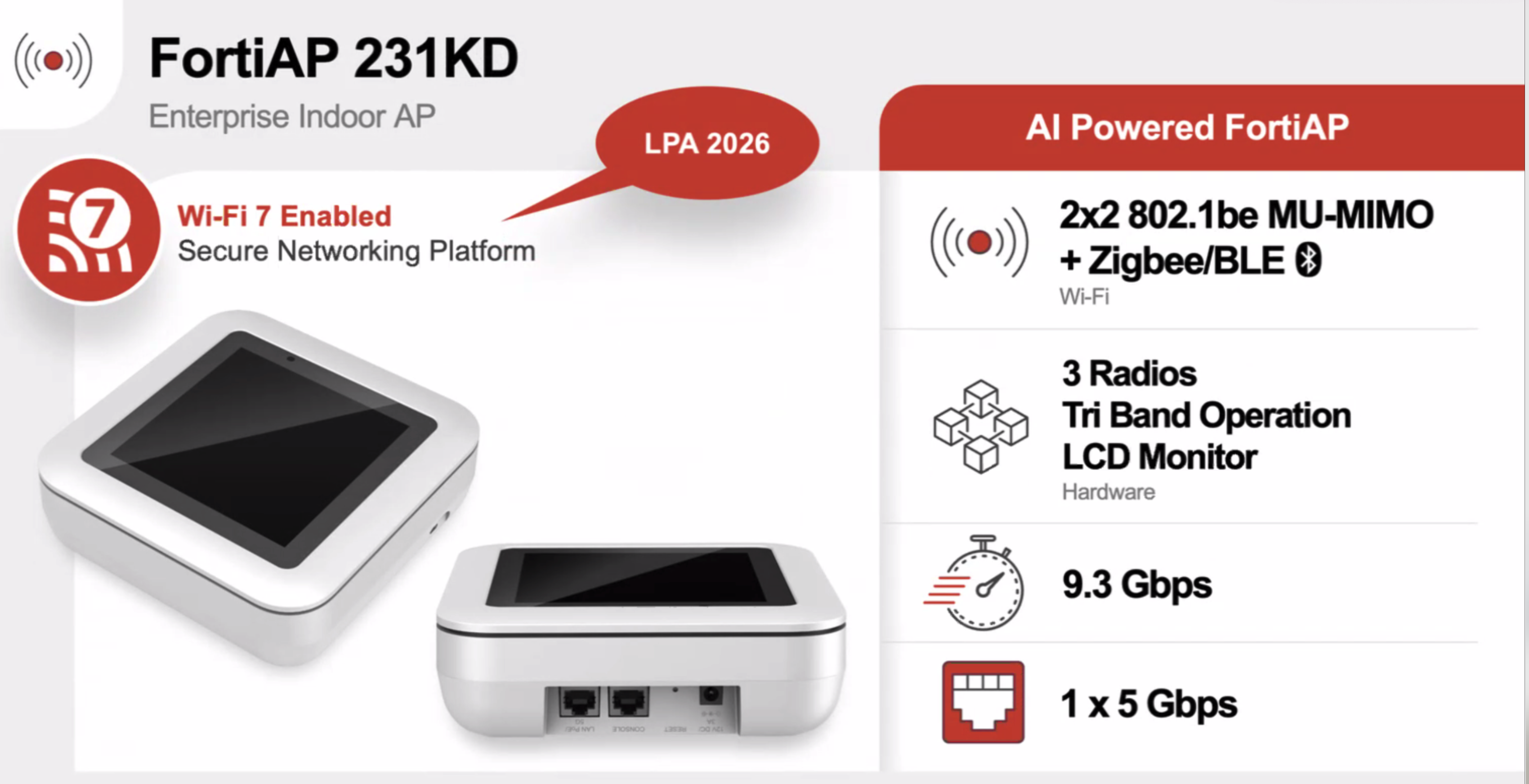
Fortinet's new concept, the FortiAP 231KD access point, caught my attention at Mobility Field Day 13—not for its Wi-Fi 7 capabilities, but for something far more unusual: a built-in LCD screen. Yes, that's right. An access point with a display.
This makes me wonder about technology convergence: Just because we can merge different technologies, should we?
The Convergence Appeal
At first glance, the LCD-equipped access point seems intriguing. Think about it like a Swiss Army knife—why carry separate tools when one device can handle multiple functions? The retail environment that Fortinet is targeting might make perfect sense to them on paper:
- Prime real estate: Access points are already mounted in-store with power and network connectivity
- Dual purpose infrastructure: One device to handle connectivity and digital signage
- Simplified procurement: IT and marketing departments can coordinate on a single purchase
Fortinet even addressed potential interference concerns by positioning the antennas at the access point's edges, away from the LCD. It's actually quite thoughtful.
Use Cases vs. ???
Let's examine whether this convergence creates actual value or just complexity masquerading as innovation.
Legitimate Use Cases:
- Retail price displays: Dynamic pricing that updates automatically without printing paper tags
- Wayfinding in large venues: "You are here" maps that can update in real-time
- Emergency notifications: Critical alerts pushed to strategically placed displays
- Corporate communications: Employee announcements in office environments
Here's my concern: Where the Swiss Army knife analogy breaks down. While a multi-tool is convenient for camping, most professionals prefer dedicated tools for serious work. Similarly, businesses might find that specialized solutions are better than converged devices.
Consider a retail chain deploying hundreds of these devices. What happens when:
- The display fails but the Wi-Fi works fine?
- Marketing wants to update content but IT controls the infrastructure?
- Different store locations need different display capabilities, or sizes?
The Support Nightmare Scenario
And this is where more of my concerns emerge. Converged devices don't just increase in functionality—they multiply potential failure points and add support nightmares.
The Multi-Vendor Support Dance: When something goes wrong, who do you call? If the Wi-Fi is solid but the display shows garbled content, is that a networking issue, a graphics problem, or a content management system issue?
IT teams already struggle with finger-pointing between hardware vendors, software providers, and connectivity issues. Adding display functionality creates yet another variable in the troubleshooting equation.
Now imagine asking the network administrator to understand display technologies, content management systems, and potentially even basic graphic design fundamentals. It's like asking a plumber to also be an electrician—possible, but not necessarily the best idea.
Network infrastructure typically has a 5-7 year refresh cycle. Does digital signage evolve much faster? What happens when your perfectly functional Wi-Fi 7 access point has a display that looks ancient compared to the latest standards? Do you replace the entire unit or live with the legacy display screen?
My Take
Fortinet's LCD access point isn't a bad idea. It's actually quite clever for specific use cases. The problem is that "specific use cases" and "mass adoption" rarely align in enterprise technology.
The device will likely find success in:
- High foot traffic retail environments where the display screen is justified
- Corporate campuses with dedicated IT staff comfortable managing additional technologies on top of networking
- Hospitality venues where guest communication and connectivity are equally important
However, for main stream enterprise adoption, it seems questionable. Most organizations are still struggling to properly design and manage their basic networking infrastructure. Adding display management to that mix feels like solving a problem that wasn't urgent. It takes away from answering questions such as, "Should we upgrade to Wi-Fi 7".
Will this reflect a broader industry pattern? Vendors seeking differentiation in increasingly commoditized markets.
The LCD access point is innovative, technically impressive, and probably useful for specific deployments. But it also represents the challenge: the more capabilities you pack into a single device, the more ways it can disappoint users who just wanted it to do one thing really well.
The question isn't whether you can deploy access points with screens—it's whether you should. And in most cases, the answer is probably no.
What's your take? Would you see value in making access points do more? The comment section awaits.